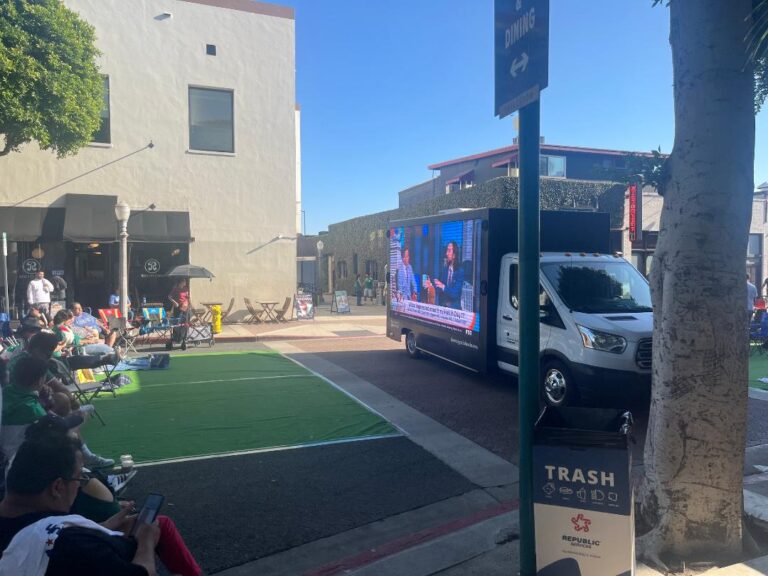
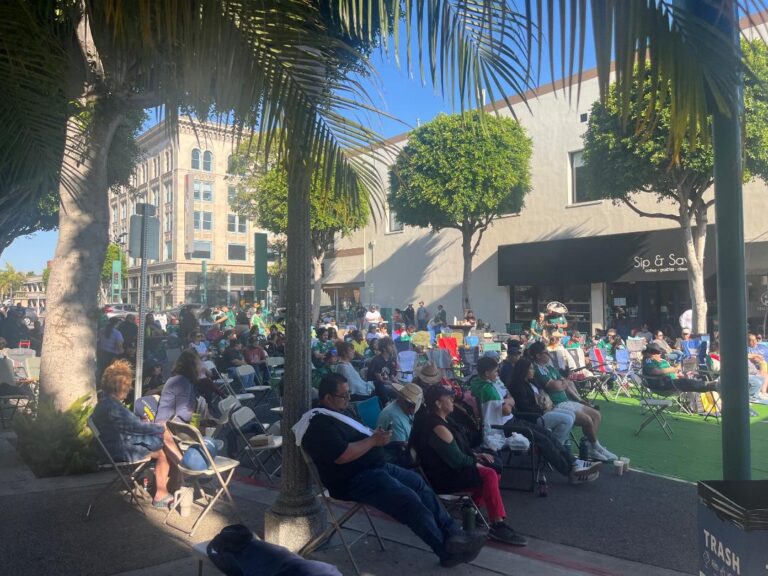
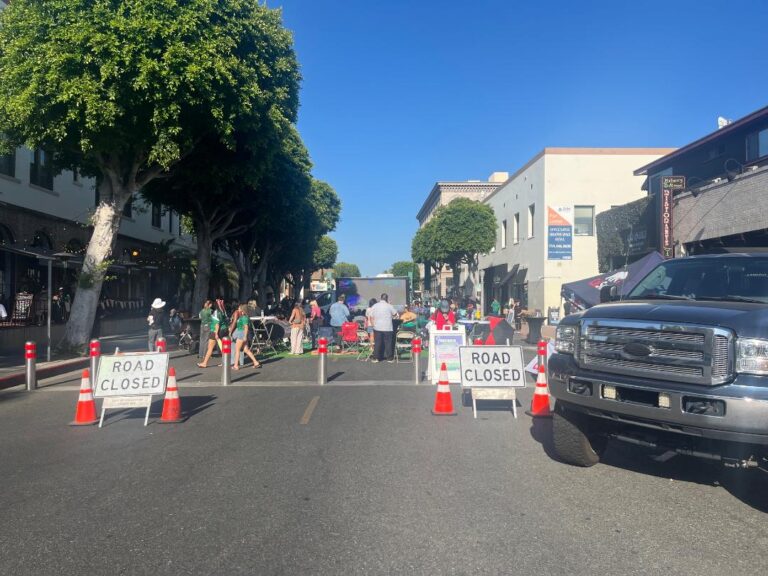
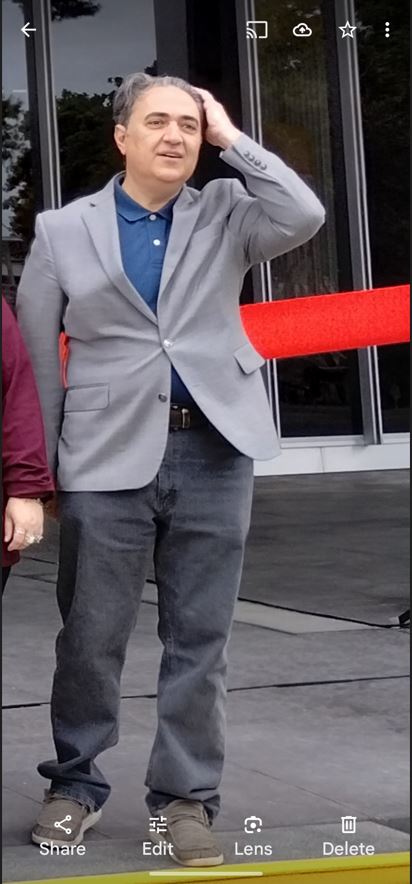
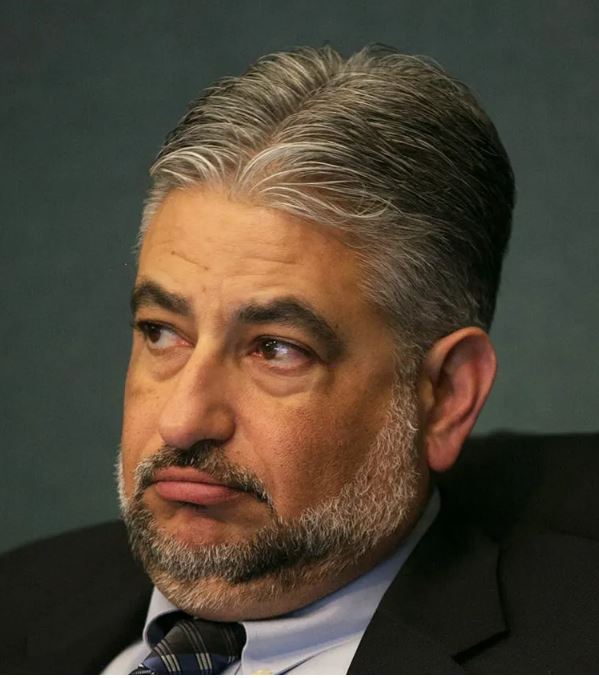
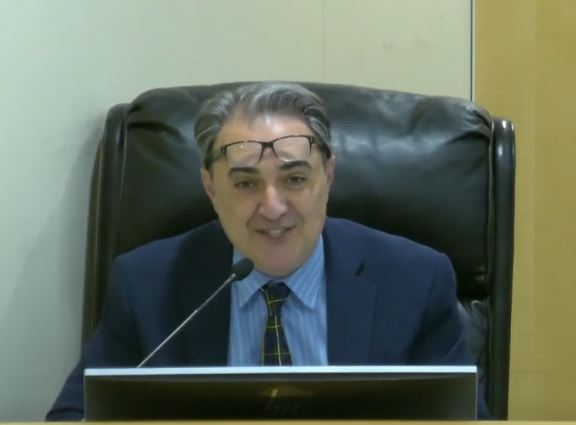
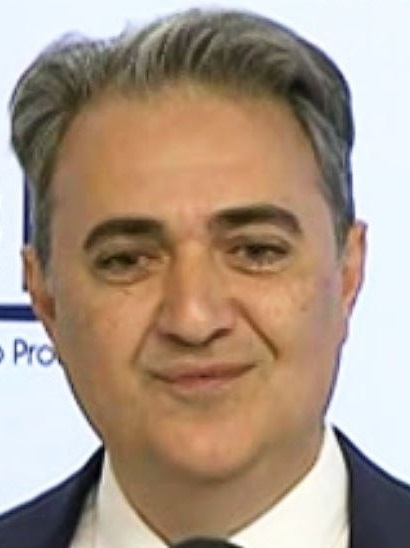
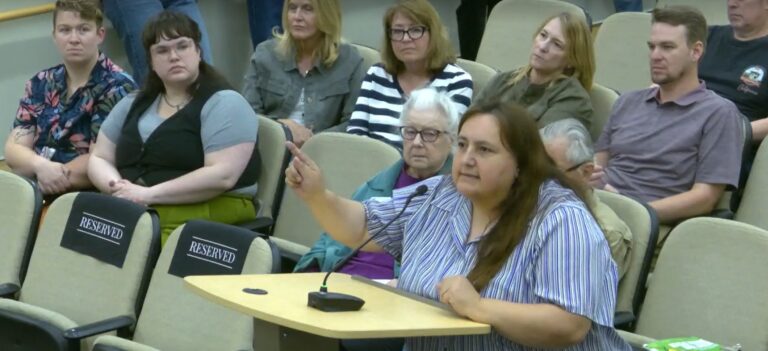
Yesterday the site of the former infamous “Walk on Wilshire” was home to a big party. The street was closed and lots of people set up chairs to watch World Cup soccer on a screen attached to a truck. A Friend sent over some images.
I don’t know anything about this get together – such as who organized it, etc. But one thing I do know is that it proved Wilshire can be closed for special events and then reopened.
This is what many people were saying all along as Fullerton’s Boohoo idiot brigade and the Observer nitwits clamored for permanent closure as an F-U to automobile traffic, and of course to residents and businesses in the 100 block of West Wilshire. Fortunately a modicum of intelligence prevailed and the wingnuts Zahra and Charles couldn’t get three votes to keep the street closed.
Put the bollards up, take the bollards down. So simple. So cheap, and so damned commonsensical. And of course nobody ever said that individual “parklets” couldn’t be utilized either, except that by the time City staff was on it as make-work, the clusterfuck naturally occurred.
So yesterday a few people were no doubt temporarily inconvenienced – instead of a lot more people being inconvenienced, and worse, all the time.
An anonymous Friend sent in the image below from a mailer hitting the Gomer Pyle look-alike Mayor of Buena Park, Connor Traut.
It seems to have been promulgated by a PAC, but that’s all I got. Is this in support of Tim Shaw of La Habra, or to help Fred Jung? Or was it just sent out by somebody that really dislikes the desperate for office carpetbagger, Traut?
I’m sharing this hoping someone can fill in the details.
Over at the Orange Juice Blog, the estimable Vern Nelson shares, among many ICE-related issues, a video of ICE thugs being escorted out of an apartment complex in Fullerton. Their exit was not accompanied by heartfelt thanks for keeping the nation safe.
Apparently the immigration cops were chasing some dude who they allege had a gun.
The Fullerton cops got involved in some unclear way and have been accused of assisting ICE – a no-no in Fullerton, I guess. The FPD chief denies his men were assisting ICE. The eye witnesses disagree. More on that, later.
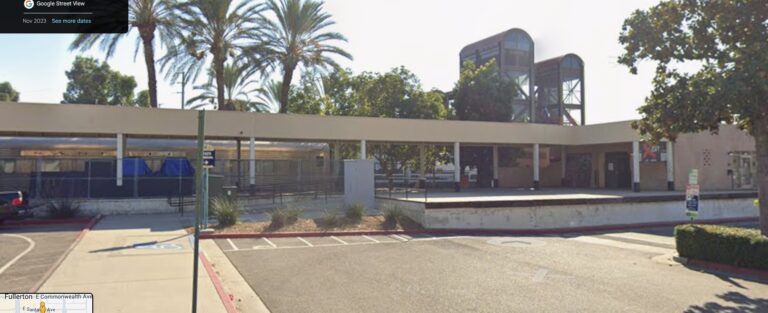
Bushala Brothers, Inc. has submitted an Conditional Use Permit (CUP) application to Fullerton’s Planning Department for the development of a restaurant on the unused Santa Fe Depot loading dock.
Now
The loading dock has been empty for decades. It was the object of an earlier City history of property acquisition. The western half the space was leased to BBI in the early 1990s, when the eastern portion was not yet owned by the Fullerton Redevelopment Agency. After the City acquired the portion east of Pomona Avenue, they declined to consolidate the lease of the entire loading dock until the past few years under City Manager Eric Levitt.
Friends will recall that the revised depot lease that now included the loading dock adjacent to the Bushala leasehold was the subject of a cooked-up controversy last summer by “Dr.” Ahmad Zahra and the Kennedy Sisters of the Fullerton Observer, a “controversy” brushed aside by the council majority who recognized the potential for this unused structure.
So the loading dock is on its way to becoming a new downtown Fullerton venue that will enliven the depot area within the Transportation Center.
After review by City staff the application will ultimately be submitted to the Planning Commission for approval.
The other day my FFFF colleague, Fullerton Harpoon, published a post on a possible move on the part of Fullerton’s annoying liberal claque to drum up support for legalizing cannabis dispensaries in town.
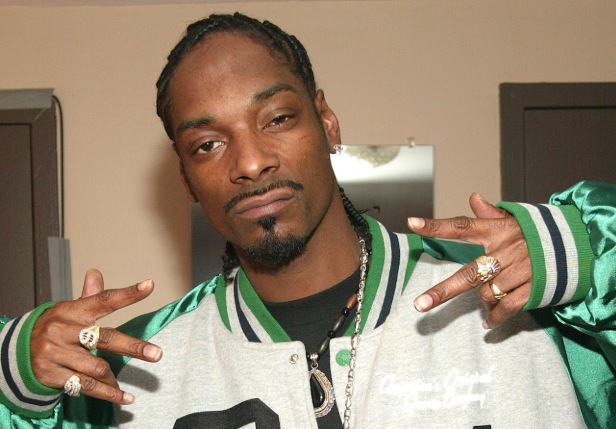
A Hip Hop Drug Guy
It’s really hard to get worked up over Doc HeeHaw’s illegal “hip hop drug guy,” and Fullerton Harpoon was quite right in pointing out the absurdity of the “it costs so much to crack down on illegal stores” as a good argument for legal dispensaries when the real reason to have them is to generate large amounts of cannabis sales taxes and fee revenue.
With the Fullerton budget in parlous condition, cannabis revenue derived from an intelligent program isn’t such an unreasonable idea.
Let’s quickly dive back into history when we examine the previous cannabis dispensary ordinance and its revocation in 2020 and 2021.
Throughout 2020 public discussion was held regarding a potential cannabis dispensary ordinance. Public input was clear people wanted a 1000 foot buffer from “sensitive receptors” such as schools, parks, and houses. In fact the consultant’s map that reflected this desire became known as “the People’s Map.”
That was the map approved for recommendation by Fullerton’s Planning Commission. But a funny thing happened on the way to the City Council.
Flory: Was I really hoodwinked?
The ordinance was pushed through by the Council 3-2, in the waning months of 2020, even though an election promised a new councilmembers. Jan Flory, Jesus Quirk-Silva, and of course Ahmad Zahra voted yes. Jennifer Fitzgerald and Bruce Whitaker voted no.
The problem that many saw was that in the modified plan there was now generous latitude of potential locations, even to have a dispensary 100 feet from a residential zone. This latitude was undoubtedly the result of dope lobby pressure on Zahra and Quirk-Silva to increase their opportunities as much as possible, and to “share the pain” as Quirk-Silva put it. The public could shove it where the sun didn’t shine.
The other obvious problem was that the ordinance invested the authority to approve cannabis licenses in the hands of the City Manager, who at the time was the incompetent Ken Domer; the decisions would be shrouded in secrecy instead of transparently, in public
The People’s Map had been sandbagged by Flory, Zahra and Quirk-Silva.
Just said no…
In December 2020 and in the early months of 2021 the two new councilmembers – Fred Jung and Nick Dunlap joined Whitaker in pulling the plug on the ordinance. No one has tried to resurrect the issue – yet.
So I have a modest proposal. Why not go back to the People’s Map? Why not go back to the earlier suggestions that would have banned these stores within 1000 feet of anybody’s residence? In addition, why not require street visibility from a Primary or Secondary arterial so everything is in plain view? Sure, almost all of the cannabis businesses would be in southwest Fullerton – Council District 5, so what? That’s the reality of Fullerton’s zoning code.
As far as other revenue options go, two proposed special sales taxes on the 2026 ballot might not pass as they require 2/3 majority; even if the council waffles toward reverting to a general sales tax there would have to be 4 council votes to put it on the ballot. Are they there? Without these revenue sources the practical financial aspect of cannabis-generated revenue appears useful.
The same argument against a special or general sales tax increase is always there: why should everybody be asked to make a sacrifice for the city’s welfare when the City Council and the hundreds of municipal employees, whose salaries and benefits paid for by the public, have sacrificed nothing?
And here’s a final thought: why not restrict cannabis revenue to specific deployment – such as roads, sidewalks and street lights?
Difficult decisions such as who gets licenses and how many there should be remain. I’m not confident in our existing bureaucracy to regulate this use successfully, but to me an intelligent rethink of the issue that minimizes citizen concerns is not a bad idea at all.
Yesterday I published a post about City Attorney Dick Jones saying the Fullerton City Council had voted in Closed Session to ask the District Attorney to investigate a possible leak of confidential information to the Fullerton Observer.
Zahra misses another bus…
I methodically eliminated all possible subjects except one – “Dr.” Ahmad Zahra, the pathological pathologist, known manipulator of the Fullerton Observer Kennedy Sisters, as well as the author of the above-mentioned “story,” green sprout Elijah Manassero.
So young, so lively, so impressionable…
I can’t say if Zahra broke the law by revealing closed session stuff to his tender young protégé, but I do know he missed the meeting completely. The ever-incurious Siskia Kennedy says he was “out of the state on business,” an odd statement given Zahra’s lack of employment, as noted in his Form 700s. Was it because he didn’t want to vote to have himself investigated?
Anyway, here’s the video again, highlighting the Jones statement and Zahra’s MIA.
At the end of yesterday’s City Council Closed Session Meeting, City Attorney Dick Jones reported that the council had voted 4-0 (Zahra absent) to request that DA Todd Spitzer’s office investigate the possible leak of closed session information.
The relevant matter was the CalPERS action and appeal with regard to four retirees who have or still work for Fullerton, post-retirement. Grover Cleveland posted about it, here.
Oh, no. Busted again.
But apparently young Elijah Manassero of Fullerton Observer fame also wrote about it for the Fullerton Observer. And his effort raised suspicion of information leaked out of closed session, which is a violation of California’s Brown Act. Government Code section 54963 provides that a person may not disclose confidential closed session information without the consent of the legislative body holding the closed session. One of the prescribed actions in the code is to turn the matter over to the district attorney.
I don’t know what sweet Elijah wrote, but it’s hard to believe he wrote about CalPERS issues without being coached by somebody who knows at least a little about them. And did this person, while coaching the tender sprout, also pass along closed session information? Somebody thinks it might have happened.
So let’s consider who this potential culprit might be. There were probably only seven people in that little room, back of the Council chamber – the five City Councilpersons, the City Attorney Dick Jones, and Interim City Manager Eddie Manfro.
A Manfro all seasons…
We may be sure that neither Manfro or Jones blabbed anything since they are both involved personally in the CalPERS problem. We know that none of the so-called “council majority” Fred Jung, Jamie Valencia, and Nick Dunlap are on speaking terms with Sanksia Kennedy’s Observer, let alone a source of confidential information. That leaves Ahmad Zahra and Shana Charles, both of whom are cozy with Observer Folk with whom they collaborate all the time.
But wait. Shana Charles not only voted to send the matter to the DA, she seconded Jung’s motion to do so according to Jones.
Found another victim!
Who is left? The dishonorable doctor from Damascus, Zahra, that’s who. And we have all have noticed Zahra’s fingerprints all over the lively and impressionable Manassero’s work product. I wonder if the DA will dig into communications between the two.
A Friend has forwarded a video captured from the City’s feed, and creatively edited:
If Zahra did leak something he could be in trouble, although I don’t know what sort of penalties have been assessed in case law. Probably not much. The Council could censure him.
Something about Ahmad and Michelle’s nuptials didn’t seem quite right…
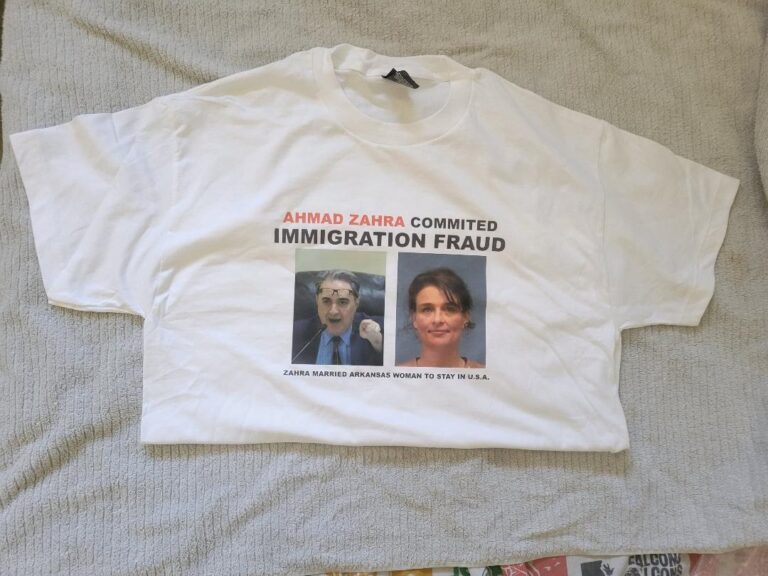
But being on the wrong side of the law and righteousness has never been much of a deterrent to Zahra. After all, he committed Marriage Fraud to stay in the country, he got rung up by Todd Spitzer for assault and vandalism, he was caught by FFFF plagiarizing water articles for the same, incurious Fullerton Observer, etc., etc.
We are left to ponder the reason for Zahra leaking information about the four individuals involved in the CalPERS deal. What would be the goal. The only thing I can think of is that he wanted to somehow embarrass Jung and Dunlap for somehow being responsible for whatever mess is abrew, and of course the “journalists” at the Fullerton Observers and the Kennedy Sisters would be only to happy to assist.
Yes, Mayor Fred Jung will be Mayor Fred Jung again. It happened at the Fullerton City Council meeting last night.
The Man Who Would Be King…
The usual assortment of Fullerton Boohoo showed up at the meeting for their annual December moan-fest about how “Dr.” Ahmad Zahra should be Mayor of Fullerton because he is a combination of Albert Schweitzer, Gandhi, Martin Luther King, and Jesus H. Christ. And also District 5, where Zahra has never got 50% of the vote, is somehow “disenfranchised” because Zahra can’t revel in the lofty title. Sputter, wheeze, etc. Ironically, one Zahra advocate explained as a qualification how the unemployed and family-less Zahra was always at photo-op events.
Comically, many of Zahra’s ardent followers couldn’t pronounce his name right, referring to him as “Za-ha-rah,” thus suggesting they don’t even know him.
But somehow the show seemed pretty muted, and sort of perfunctory; maybe it was because Zahra wasn’t even at the meeting and this meant that his getting three votes wasn’t in the cards.
Say goodbye to my nice policy…
Zahra minions spoke about the policy of mayoral rotation made years ago by other city councils that must be adhered to, even though the City Attorney had said a council majority could set it aside anytime they want, making the policy meaningless.
What will 2026 have in store for this one…
The endlessly self-impressed gasbag Shana Charles said it was also her turn to be mayor, cuz she had just been Mayor Pro Tem, and ya know, policy. She is running for re-election next years and probably thought, delusionally, that she had a shot at the Title. She didn’t.
In the end Valencia nominated Fred Jung who was appointed Mayor; Nick Dunlap was nominated, and appointed Mayor Pro Tem.
I am the light, the truth and the way…
No one within the boohoo tribe has ever bothered to honestly figure out why the council majority has steadfastly refused to appoint Zahra to be mayor. It’s chalked up to selfish personality issues on their part, but we know the real reason. No one whom Zahra hasn’t fooled with his phony immigrant schtick and faux sincerity wants to hear his long-winded, self-praising bloviation and his promotion of his “brand.” They resent his constant condescension toward them, his performance of moral superiority, and his hysterical, behind the scenes behavior.
The same applies to the majority’s opinion of Shana Charles, with her smug, incompetent, speechifying. She loves the sound of her own voice, alright, but nobody else loves the bi-monthy waste of time that just interminably drags out meetings. Even Nick Dunlap, who nominated Charles to be mayor Pro Tem a year ago, has evidently had enough of her tedious monologues.
Speaking of Dunlap, he did excel himself before the vote, noting that the same 40 people (it’s probably closer to 20) who show up at council meetings do not represent the public or the community and that he had been elected to represent everybody. Well done, there, Mr. Dunlap. They won’t get it, but need to be reminded once in a while.
That’s Mayor Jung to you, Sankia…
So Fred Jung gets to use the title “Mayor” during his campaign for County Supervisor which is a help in the odd world of local politics where almost nobody is paying attention to real accomplishments or real failures.
Is it true. When his lips are moving he’s generally lying, as the saying goes.
It was all about “serving,” mostly serving himself, of course. Never forget: his second big decision was to get himself appointed to the lucrative OCWD board in exchange for appointing Jan Flory to the City Council in 2019; his first big decision had been to call for a replacement election.
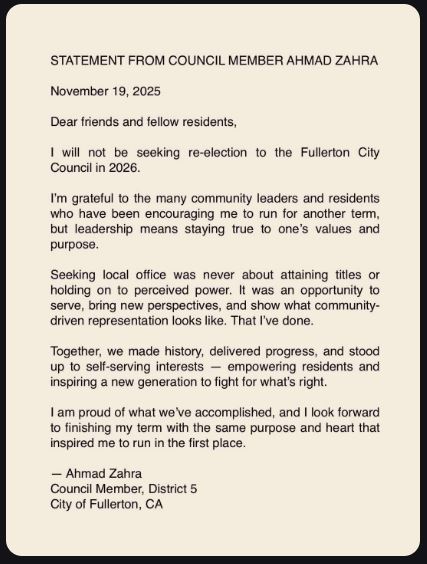
“Community-driven representation” means stirring up a handful of uninformed people to harangue honest council members and bully them into submission on a useless $2,300,000 trail through a blighted industrial area.
Is this a true statement or only a feint? Is it a mechanism to win sympathy for a mayoral appointment on December 16th? The latter certainly isn’t going to happen any way you slice it. Or is this a realization that his self-serving ego leap is over and that he landed in the sand some time ago?
It could be worse. It could be Speed Metal! Wait. It is!
Last night the Fullerton City Council, at long last, approved a noise-related addition to the Municipal Code. The vote was 3-2: Jung, Dunlap, and Valencia for, Charles and Zahra voting no.
This effort has been going on for over ten years, has been diddled with by more than ten City Councilpersons (Flory twice), and five City Managers, acting and permanent.
The ordinance is pretty tame really, with decibel levels I think are way too high, but at least gauged at the property line where the goofy and distracting issue of “ambient noise” can be better put to rest. Hours of outdoor music have been addressed with common sense and respect for neighboring inhabitants.
Fines for violators are in place, and about time, too.
For the business…
It was amusing to watch Zahra and Charles pretend to be “pro-business.” We know the performance was disingenuous because of their cavalier attitude to non-bar businesses on Wilshire Avenue that suffered when that pair closed the street for their absurd “Walk on Wilshire.” They ignored the fact that downtown Fullerton runs in the red and is subsidized by the rest of us. Really their act was about voting against what they characterized as the wishes of “one businessman” regardless of the need for reform.
In what surely must be the dumbest thing said in recent years at a council meeting, Ahmad Zahra claimed as a fact that the “downtown is dying,” a really weird and irresponsible thing to utter. The Dismal Damascus Doctor offered exactly zero facts to support his stupid utterance.
Transparency, uber alles!
Naturally, our friend sweet young Elijah Manassero popped up to inform the council that most of the bar owners were already non-compliant with the new rules. His logic led him to conclude that therefore the new regulations were ill-advised. It didn’t seem to occur to the tender sprout that the continual bar-owner abuse of existing law was precisely why the new ordinance was needed. I have no idea what they’re teaching the young folk these days, but thinking doesn’t seem to be in the bundle, although I’m sure callow Elijah has loads and loads of self esteem.
Now it will be time to see if the City Code Enforcement operation will employ the willingness and the competence to enforce the law. They have stubbornly refused to do so in the past, partly because councilmembers were running interference for the scofflaws. And part of the reason for staff’s reluctance might be because enforcement implies some sort of fault or failure, and in City Hall the decades long mess they made out of downtown Fullerton, has been characterized as a stunning and inarguable success.