This YouTube clip of a recent Fullerton Redevelopment Agency strategy/workshop session is a must see for anyone who wants to see how their decisions are made. The audio has been artfully overdubbed to protect councilmembers from appearing ridiculous and thus preserving the dignity of their office.

Back in the balmy summer of 2007, the weather was great – just perfect to spend some time on the water. Lobbyist, front-man, promoter, and all-round cash-conduit Steve Sheldon (not pictured, left) hosted a cruise on his boat the S.S. Cash Cow around Newport Harbor, to be followed by a scrump-diddly-umptious dinner at a swank Newport Beach restaurant. It wasn’t free. Lucky invitees had to cough up $1000 a piece for the priviledge, and that ain’t chump change. The beneficiary of this lobbyist largesse: Fullerton City Councilwoman Sharon Quirk.

Now, Loyal Friends, why would Sheldon organize such an event? Because that’s his job! He represented the “developer” of the massive Jefferson Commons project over by CSUF that would require a general plan amendment and a zone change, demolition of historic buildings, loss of OP zoning, and the usual slide-and-glide job on the required EIR. When you’re in Sheldon’s business you don’t take chances, and of course you wheel your bets.
Any way you slice it, Sheldon performed a big favor for Quirk; and guys like Sheldon know it’s natural for nice people to repay favors.
Among the attendees of Sheldon’s nautical shake down included representatives of John Laing Homes and Pelican Properties – the would-be developers of the “Amerige Court” project – another mammoth project that threatens to consume downtown Fullerton.

And so (to return to our maritime theme) on one pleasant summer day, the developers of two of the biggest proposed monstrosities in Fullerton’s history spent a lovely summer afternoon schmoozing with Mayor Pro Tem Sharon Quirk – presumably sharing the wonderful plans they had for the future of Fullerton. There were a lot of good feelings on board that afternoon, even before the sun crossed over the yard-arm.

Hardly more than a year had passed before Quirk had voted to approve both these overbearing projects – with their dubious environmental reviews, and the evident negative externalities the get-rich-quick entitlements foisted on the rest of us.

Now, in logic there’s a fallacy known as the post hoc, ergo propter hoc, which means that just because B follows A, it doesn’t follow that A caused B. And we’re not claiming that Quirk’s vote was bought by the high-rolling developers and their front man. Quirk could probably come up with all sorts of reasons for supporting these projects on their own merit. We can’t think of any ourselves, but if you can, Devoted Readers and Friends, please feel free to share them. And if Ms. Quirk is reading this, she, too is invited to explain why these projects are so good for Fullerton. We will be happy to give her response its own post – but only if she promises to write it herself!
Last night we sat through the horrendous hearing on Redevelopment expansion. It was really a pretty painful thing to have to endure.

City staff and their consultant put on a performance that can only be termed embarrassing. To describe it any farther would do an injury to my synapses, and so I’ll pass. Their presentation was eviscerated by Councilman Shawn Nelson and several speakers from the public – notably former Councilman Conrad Dewitte, former Congressman Bill Dannemeyer, GOP Central Committe member Bruce Whitaker; and perhaps the best of all, Jane Reifer . We note that our lawyer Bob Ferguson showed up too. We can smell a lawsuit coming.
The case boils down to this: you can’t create a Redevelopment project just because you need the money. It’s been done for years, but judges are finally starting to uphold the law. About time.
One of the words that the cheerleaders of the expansion kept using was “tool” and this sure was appropriate since city staff and the Jones/Bankhead team dredged up a number of tools to come to the meeting and add moral support.

There was Theresa Harvey of the Chamber of Commerce who mumbled and stumbled her way through a statement clearly not written by her; a character by the name of Rick (or Dick – can’t remember) Price representing an outfit that goes by the hilarious name “Fullerton Positive” and wears smiley face buttons on their lapels; John Phelps – one of the biggest welfare recipients in Fullerton’s Redevelopment history ; and former councilman Peter Godfrey – who could only be seen from behind. It was nice to see Peter again, if only his backside, to remind us of his vacuous tenure on the council and recall that he was one Linda Lequire whip crack away from voting to keep the obnoxious Utility Tax.

As expected Bankhead and Jones were shilling hard throughout the hearing, Jones giving one of his brilliantly cuckoo rants complete with crazy gesticulations.

Since Pam Keller recused herself, Sharon Quirk became the necessary third vote and she kept noncommittal, sensing no doubt the political pitfalls of either position. She asked a lot of questions that seemed rehearsed with staff, and acted like she wanted more information from the lame consultant. We have to question her sincerity since she’s already had plenty of time to lay out the ground rules before last night – the proverbial 11th hour. And so we got the strong sense of a kabuki performance. The simple fact is that Quirk could have killed the deal last night. The fact that she permitted the monster to live indicates she will be going for this when it comes back on June 18th.


It seems a little strange that an organization that purports to support the interests of business would allow itself to become an impotent pawn in a game run by and for city bureaucrats. And yet that is exactly what has happened.
This afternoon the City Council received an e-mail from Theresa Harvey, Executive Director of the Chamber in support of the proposed Redevelopment expansion on tomorrow night’s City Council agenda. The letter attached to the e-mail would be comical if there weren’t so many dues paying members of the Chamber who will get screwed by Redevelopment.

Harvey starts out by trotting out all the old cliches about infrastructure, housing and business climate. What she utterly fails to mention is how Redevelopment diverts a finite amount of disposable income of consumers from existing businesses to new ones; how it invites bureaucratic interference in business decisions, thus impinging on entrepreneurialism; how it requires business and property owners to endure the idiotic design review process; how it selects favored businesses and “developers” as winners, to the detriment of others. In short: Redevelopment does not work. it is a government ponzi scheme that leverages bonded indebtedness off of property tax revenue; it discriminates against the majority of businesses in favor of a few; and any policy or program that discriminates against the majority of business is, by definition, ANTI-BUSINESS!
Ms. Harvey decorates her tribute to Redevelopment by citing the “charm” of downtown Fullerton. Anyone who has been reading these pages lately knows that whatever charm Fullerton has, it has in spite of Redevelopment, not because of it. Does she support giving away public sidewalks? Does she approve of squandering millions of dollars to move a fast food outlet 200 feet? Does she like giving away free public land to developers? She must. She must like it a lot.

You would think that the businesspeople on the Board of the Chamber of Commerce would have enough sense to grasp these simple notions. But when you reflect on the fact that our old friend Dick Jones, a government educated doctor, used to be the president of the Chamber, the institutional dysfunction of this group can be discerned in much clearer focus. The Fullerton Chamber of Commerce has become nothing but a sissified adjunct of City Hall, confusing their own alleged mission with that of the City apparatchicks.
To the members of the Fullerton Chamber of Commerce: stop paying your dues until your Executive Director and Board start defending business instead of government expansion and bureaucracy!

UPDATE: We are republishing this wonderful post by Fred Olmstead originally posted on February 21, 2009. We do so in order to highlight the fact that the park – suffering from real blight – is in the Redevelopment project area, and stands as yet another testament to the failure of Redevelopment. Sharon Quirk, are you reading this?
– The Fullerton Shadow
Loyal Friends of Fullerton’s Future, gather ‘round the cool glow of your computer terminals and follow a sad saga of miserable municipal negligence.
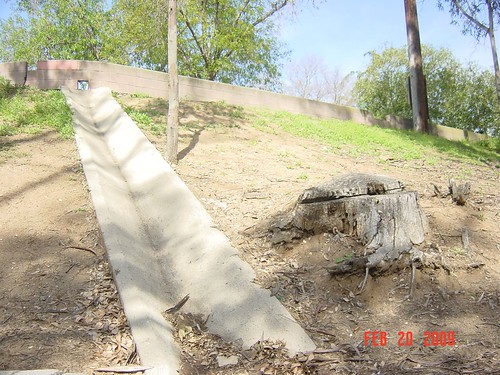
Located in the center of Fullerton is a resource of inestimable value, overlooked by almost everybody in and outside of City Hall: Hillcrest Park. Included in an early vision of the city it followed upon the City Beautiful, and natural urban park elements of the Progressive movement; and coincided nicely with the new auto culture of the 1920s, positioned as it was, along the original Highway 1.
Developed fully during the Depression in a rustic mode, the park soon after began a long decline into municipal irrelevance, and if anything, seemed to be perceived by many as a liability rather than a great asset. This tragic trajectory is a shameful blot on Fullerton’s history and is akin to placing your eighty-five year old mother in a criminally negligent nursing home.
After Don Bankhead and Fullerton’s Finest chased out the acid-dropping hippies in the 1960s, the park became a haven for perverts; trees began to die and were not replaced; erosion claimed many of the north and west facing slopes and was not arrested; as the infrastructure crumbled it was replaced by City Engineer Hugh Berry with incongruous cinder block walls and concrete light poles.

In the mid-1990s Redevelopment Director Gary Chalupsky, in a philanthropic mood, decided that Redevelopment funds could be used to address Hillcrest Park issues – the first official over-the-shoulder glance toward the park in years.
And here, dear Friends, the story turns from a chronicle of benign neglect to one of outright incompetence and, one might plausibly argue, a form of bureaucratic malevolence.
In 1996 the usual scoping/charette pantomime was performed with an historic park landscape architect, specially imported from Riverside. An odd thing happened: every time the consultant prepared a list of priorities for the park, the Community Services Department’s wishes kept getting pushed to the top. The Director of Community Services was Susan Hunt, a woman long known for her mindless turf battles with her constituents – (including the Isaak Walton Cabin in Hillcrest). Hunt was determined to hijack the process and divert resources from where they were needed to facilities that she and her department could control and perhaps even profit from.

Hunt was successful. The consultant, knowing whom it was important to please, seemed only too happy to abet the fraud that was perpetrated. The city council (including current Jurassic members Bankhead and Jones) went along. Chris Norby was there, too. Now he’s in charge of the County’s parks.
A new playground replaced the old one in the Lemon parking area even though no one had complained about the existing one that parents seemed to like. More egregious still, a new facility (known as Hillcrest Terrace) was built behind the Veteran’s building that could be rented out for social functions. But the real needs of the park – slope stabilization, plant cataloguing and replacement, the removal of inappropriate elements – went unaddressed – and the problems have continued unabated to this day, ten years later, as interest in the park waned again.
Last fall the City once again roused itself from its somnolence and created an ad hoc committee to consider issues related to Hillcrest Park. The time is, perhaps, propitious. Susan Hunt has disappeared into an overdue and well-compensated retirement, current Director Joe Felz is much more amenable to citizen input. It’s time to reclaim this park.
Hillcrest is still in the Redevelopment Area and remains affected by indisputable blight. This should become a priority for Redevelopment Director Rob Zur Schmied.
While we wonder if the Hillcrest Park committee will actually display the necessary independence from staff manipulation, and that they possess the necessary technical abilities, we wish them well. And we encourage citizens to make sure that this time any assessment of Hillcrest will objectively address the needs of the park and report directly to the City Council. Recommendations should be included in the City’s Capital Budget.
Hillcrest Park can and must return to being the crown jewel of Fullerton’s parks.
On May 5th, the Fullerton City Council will once again take up the matter of a vast new Redevelopment land grab in Fullerton. The bureaucrats in City Hall want to appropriate all the property tax that they can by throwing the Redevelopment net over a huge swath of the City. In order to do so they must find “blight” and they must be able to prove it. So far they haven’t. They never will.

What does “redevelopment” mean in practical terms? It means the diversion of property taxes from other government agencies; it means the power of eminent domain over law-abiding property owners; it means more massive developments by favored developers; it means more design mediocrity – or worse.

Devoted Friends of Fullerton, over the past few weeks we have favored you with a litany of loose accountability and lax responsibilty exhibited by Fullerton’s Redevelopment Agency over the years. These sad stories have detailed incompetence, government overreach, bureaucratic usurpation of sovreign authority, the serial uglification of downtown Fullerton; and worse still, our tales have shown the happy compliance and enthusiatic support of the City Councilmembers for all this misfeasance.

Although some of the Redevelopment case studies of mismanagement and boondogglery we have related occurred in the 1990s, nothing has changed. The fact that Don Bankhead and Dick Jones can still cheerlead for this failed – and failing – government entity only goes to show how irresponsible it would be to permit the metastasis of Redevelopment in Fullerton. Harnessed side by side, these two have trudged through the last twelve years approving most of the Redevelopment disasters we have recounted to you Friends.

So now we are at the proverbial eleventh hour; what will happen on Tuesday? Jones and Bankhead(Joneshead?) are on safely board. Nelson is on record as opposing the expansion; Keller seems to be opting out because of a conflict of interest. This leaves Sharon Quirk as the necessary third vote. Although every instinct in her body must be telling her to go with the staff and the good old boys, to just follow on the slip-stream of inertia, we think she may be entertaining some nagging doubts. Even if these doubts are of a political character, we will embrace them as if they were the heartfelt and genuine response to our brilliant posts on the history of Redevelopment disasters in Fullerton.

On Tuesday we will be watching Quirk. She will have the rare opportunity to do the right thing – to refuse the expansion and to say why: Redevelopment does not work. It is a scam. It invests authority in people who are not qualified to exercise such authority and it engenders both incompetent government action and lack of accountability for those who act ineptly or even illegally.
Quirk’s choice is really pretty easy.
In the year 1992 Fullerton’s City Manager Bill Winter was just about out of gas. He had been running on fumes for quite a while and figured it was time to rest on his threadbare laurels. He could also see the handwriting on the wall. A practical cipher, he had let Hugh Berry run the city and the Redevelopment Agency. A culture of permissiveness obtained at City hall during his tenure. Things were about to change – but not for the better.
The Council hired James L. Armstrong to replace Winter. He had been in Anaheim as an Assistant City Mananger and had also done a term at Hanford located somewhere out in the miasma of the San Joaquin Valley.

Armstrong arrived just as the 90s recession was beginning to sink its teeth into the local government wallet. Revenue was falling and something had to be done to protect city workers. Lack of revenue threatened automatic “step increases,” raises, and City PERS contributions. Perhaps Armstrong felt he had the solid backing of the City Council, but the Fullerton novice certainly had no reading of the mood of the electorate.
Within six months of assuming his new job, Armstrong had persuaded Molly Mc Clanahan, Buck Catlin, and Don Bankhead to go along with the imposition of a new Utility Tax. They deliberately denied a plebescite – knowing as they did that it would be rejected. And so they held the usual dog-and-pony budget hearings, passed a budget based on the Utility Tax, and approved the tax, too. Bankhead and Catlin were allegedly conservative Republicans, but that soon became an apparent farce; even worse, Bankhead had run for re-election in the fall of 1992 promising no new taxes!
The citizenry rose up in fury! Raising taxes during a recession just to protect city employees? The tocsin was sounded and an strange new locution echoed through the corridors of City Hall – Recall! The word had never been uttered in staid, conservative Fullerton before. The statists and the public employee unions, and Fullerton’s good-government liberals were aghast. The newly energized pro-recall crew were seen as outsiders – who are these people, they’ve never served on one our precious committees! Barbarians at the gates! God, almighty! Civilization itself was at stake.

Within a year the Recalls Committee, gained their signatures, placed a recall on the June 1994 ballot, and successfully recalled Catlin, Bankhead and McClanahan. He had only been on the job eighteen months, but our hero Armstrong had instigated a municipal civil war, and had managed to mismanage three of his supporters into ignominious political humiliation.

The way things ultimately worked out, the new Councilmembers were no better than the old. But the Utility Tax was repealed during the interregnum; without it the City got along just fine. But because the Old Guard had managed to hang on to elected office the managers in City Hall never had to confront the consequences of their point-blank refusal to reconsider the way they ran their departments. This was Fullerton after all.
Meantime Jim Armstrong was a busy fellow. He presided over just about every Redevelopment fumble, boondoggle, and cover-up of the 1990s; he made it very clear that when bureaucrats blundered the wagons were to be circled and nobody (in City Hall) would be any the worse for it. The jewels in his tarnished crown were the attempt in 1993 to forestall the Depot corrective work caused by incompetent design (full story coming soon), the complete mismanagement of the new Corporate Yard project, the deployment of attack dog Susan Hunt – whose job was to kick all citizen groups out of city facilities and keep them out, and his mania to turn public facilities into cost centers administered by city employees (see related post on Hillcrest Park).

An aura of arrogance clung to City Hall like the ripe aroma surrounding the local Materials Recycling Facility; the City Council was just there to ratify Armstrong’s policy. If they liked that, so much the better. And they sure seemed to.

Armstrong’s miserable misrule came to an end in 2001 when he took the top job in Santa Barbara – you see in Jim’s line of work nothing succeeds like failure. And he set the bar high for his successor, Chris Myers, who learned from the best: when you find a cushy spot like Fullerton where nobody demands accountability, stick to it like a barnacle – until something better comes along. In the meantime – close ranks, clam-up, and cover up.
Thank you Forebearing Friends, for following this pathetic revelation to its conclusion. The unwinding of this concatenation of miscreance and misfeasance must be as hard to read as it has been to write. And yet now the conclusion is finally at hand!
By May 1997 the SRO deal was done. The final meeting was a mere formality. Everybody who was paying attention knew that Dick Jones – yes, all hat and no cattle Dick Jones – was going to eat up the tasty morsel that his own staff and collegues had put in front of him.

Terrified of personal loss, and with apparrently no confidence in City indemnification, he caved in to the ridiculous threats to protect his own pelt. All of his brave words of March were just so much verbal gas.

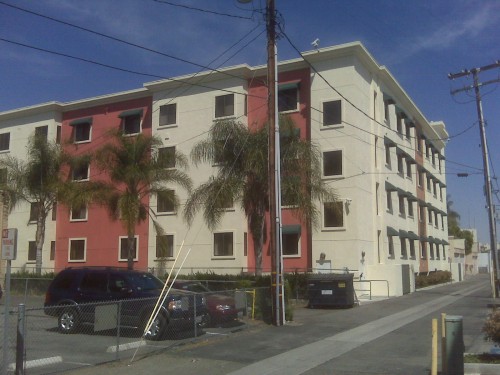
The meeting came and went. The project moved ahead and was ever so slowly built. Two years later the Fullerton City Lights was added to the Downtown scene. The city bureaucrats congratulated themselves on another job well-done: 7 years and several million dollars of public funds in the making – a large stucco box. The erection wasn’t much to write home about.

Perhaps the sorriest part of this saga was the behavior of Dick Jones – during and after the sad episode. He had eaten his crow – the feathers were still there on his bib for everybody to see. And councilwatchers were wondering if his former fulminations would now be directed at the staff and fellow councilmembers who had placed him in his embarrassing predicament. The answer came quickly. No accountability, no responsibility – nothing. Nothing but loud and consistent praise and support for the bureaucrats who had orchestrated his humiliation; he soon became notorious for his knee-jerk and unquestioning support of almost everything put in front of him by the City staff.

All that remained was the peridoc bluster: homespun nonsense, loud, rambling and often incoherent perorations. Deep-fried bloviations, full of sound and fury, signifying nothing.

Read the rest of “Fullerton’s City Lights”: Part 1 – Part 2 – Part 3 – Part 4 – Epilogue
Loyal and Patient Friends, our long narrative of the City Lights SRO is coming to a sordid climax, and a merciful denouement. We have witnessed incompetence, vindictiveness, cultural vandalism and bureaucratic usurpation of authority, But we’re still not finished. The SRO project appeared dead. The elected representatives had killed it. Democracy at work! But as long-time city-watchers know, the project is only dead when staff says it’s dead, and none of the architects of this disaster – City Manger Jim Armstrong, Planning Director Paul Dudley, or their puppet, Redevelopment Director Gary Chalupsky, wanted it dead. Because that would be an admission of what everybody else already knew – they were largely incompetent.

We left off with Dick Jones at a March, 1997 meeting waxing voluble about drug users and their nefarious ways. Nuh-uh, not in my city! Unfortunately, Jones discovered that getting the foot into the mouth is a whole heckuva lot easier than extracting it.

Jones was not acute enough to pick up on clues that the City Manager, Flory and Bankhead were not going to let this die. He should have been clued in during the March meeting by the Agency attorney, who, at the insistence of Flory, Bankhead, and a clueless Julie Sa, gave a legal opinion in public stating that Mithawalla could have a case against the Agency. Here’s where the story gets a bit murky, culpability-wise, and who orchestrated what, so rather than accuse anybody we’ll just let you – the Friends of Fullerton – draw your own conclusions.

A civil rights lawsuit was adventitiously filed against Jones and the City by some guy nobody knew, claiming that the targets of Jones’ tirade were protected under the Americans with Disabilities Act; Mithawalla was waiting in the wings to go after the City for breach of contract – although clearly no contract had been established. With enough proper coaxing from people who wanted this project to live, Dick Jones, the Big Man with The Big Mouth suddenly experienced a case of shrinkage.

A new hearing was held in May 1997. The stage was re-set to take up the SRO project one more time. It didn’t matter that the Council majority had already spoken. The City Staff, the Redevelopment Attorney, Flory and Bankhead were determined to have the last word in order to remind everyone who really runs the City of Fullerton.
Read the rest of “Fullerton’s City Lights”: Part 1 – Part 2 – Part 3 – Part 4 – Epilogue

Loyal Friends, when we left off our last post the City’s chosen SRO “developer,” Caleb Nelson” was gone: whether he left voluntarily or was shoved aside is a moot point. He left behind an unstarted project, a history of City bungling, and an embarrassing hole in the cityscape. Sometime in 1996 Redevelopment Director Gary Chalupsky discovered a replacement. Apparently on his own authority he chose Agit Mithawalla to take over the project. No public hearing, no RFP, no prequalifications, no City Council approval. Behind closed doors a new deal was hatching.

And the City Council had changed. And changed again in the fall of 1996. Jan Flory was now on the Council since 1994, trying to rewrite Recall history and a sure bet to cover up any staff misfeasance. But the newly minted councilman Dick Jones was on the dais. He had run as the voice of conservatism in Fullerton and it was known that his pals in the Chamber were dead set against an SRO across the street. Public housing – the horror!

When the final agreements with Mithawalla finally reached the Council for approval in March 1997 a showdown was prepared by irate citizens who opposed the SRO project for one reason or another. Some cited inflated construction costs; some objected to deal for financial reasons; other attacked Mithawalla’s record of shoddy building in LA. When the vote came down the agreement was voted down 3-2. Bankhead and Flory, predictably, backed up the staff mess completely; Chris Norby rallied Jones and Julie Sa to oppose. Dick Jones gave the very first of his corn pone diatribes, in which he hurled invective against the project, its likely denizens, and the methadone clinic next door.

He was Big. He was Brave. He would soon come to regret giving voice to his peculiar worldview…
Read the rest of “Fullerton’s City Lights”: Part 1 – Part 2 – Part 3 – Part 4 – Epilogue